
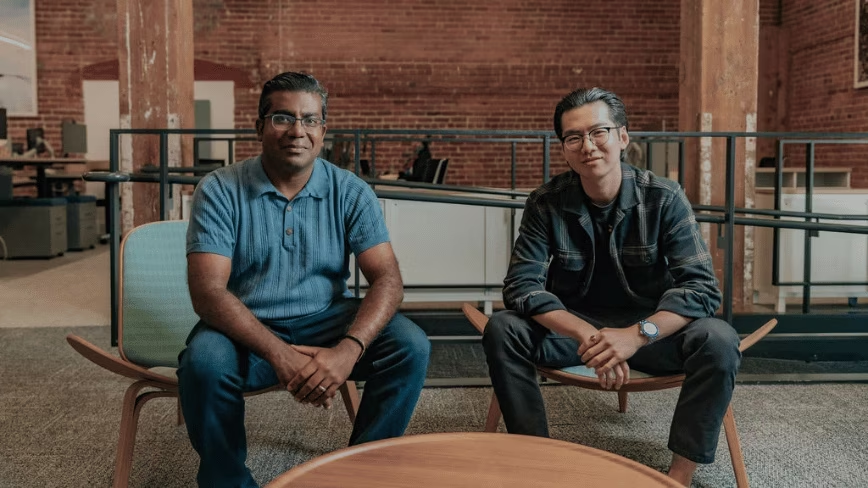
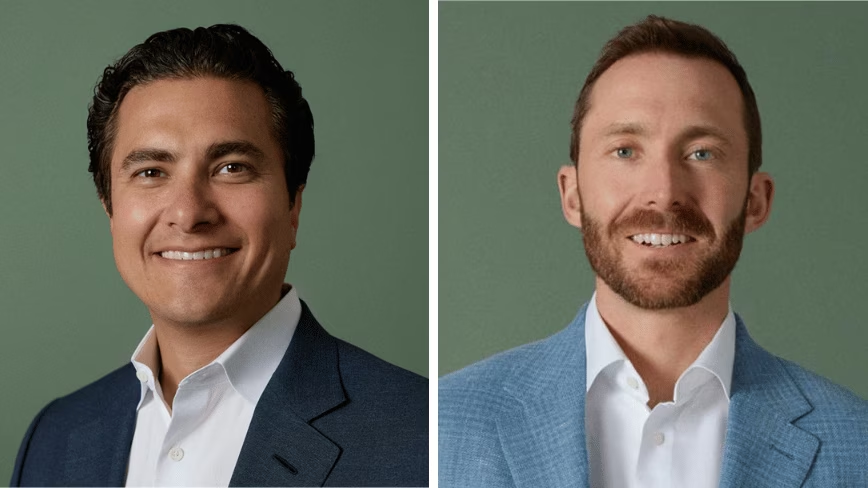
Nilam Ganenthiran, founder and chief executive of Beacon, left, with Leonard Tang, who joins as vice president of AI research. Credit: Beacon “The Fortune 500 will have no shortage of AI,” said Leonard Tang, co-founder and chief executive of Haize Labs. “The harder problem is making AI useful for the businesses that power the rest of the economy, where most humans work and receive value.” Tang said that in a statement confirming that Beacon Software has bought his company. Beacon announced the acquisition on 17 September. Terms were not disclosed.
Haize Labs sells red teaming, guardrails, evaluation and observability tools. That is the software that stress tests AI systems and then watches what they do in production. Beacon is a Toronto holding company that buys software firms serving recreation, utilities, education, government and manufacturing. From frontier labs to campground software Tang started Haize Labs in 2024.
It worked on red teaming and safeguards with the frontier labs. It sold an evaluation and monitoring platform to large enterprises. It also ran a pro bono programme for small businesses, Tang wrote in a LinkedIn post. His team now becomes Beacon’s Applied AI Research Group.
Tang joins as vice president of AI research. He will lead the AI operating system that Beacon deploys across the companies it owns, and co-founder Steve Li moves across with him. Beacon owns 45 software companies. Those companies serve more than 22,000 businesses and institutions, Beacon said, “from campgrounds to construction companies”, and many of the relationships go back decades.
TNW reported in June that Beacon had raised $225m to buy what it calls Main Street software and rebuild it with AI. Its founder pitched the model as the opposite of private equity. Nilam Ganenthiran founded Beacon and runs it. He was previously president of Instacart and a partner at D1 Capital.
What the new group will build Beacon listed four priorities for the research group. The first is reusable AI infrastructure that carries across the portfolio without erasing what is specific to each company. The second is turning domain expertise into evaluation and feedback systems. Those systems define what good looks like in each business.
The other two sit closer to what Haize already sold. One is continuous testing, red teaming and observability for AI agents, before and after deployment. The other is products that cut administrative work, improve customer service and help the portfolio companies grow. “Main Street businesses deserve access to the same caliber of AI talent and technology as the world’s largest companies,” Ganenthiran said in a statement. “Haize Labs brings exceptional engineers to Beacon who know how to find where AI fails and make it better.” Beacon is hiring engineers, product managers and researchers to work alongside the Haize team. What the announcement leaves out Neither company put a price on the deal.
The announcement does not say what happens to Haize’s existing enterprise customers. Nor does it say whether the work with the frontier labs carries on, now that the engineers report into a holding company whose customers run campsites and building firms. The market has been buying this capability rather than building it. Harvey bought Guardrails AI this month, alongside a $550m round.
OpenAI bought the open-source red-teaming tool Promptfoo in March. Ganenthiran set the test plainly in his own LinkedIn post. The hard part, he wrote, is making AI reliable enough that people can depend on it every day. That is a narrower promise than most AI marketing makes.
Agent reliability is where it gets judged.






Leave a Reply