
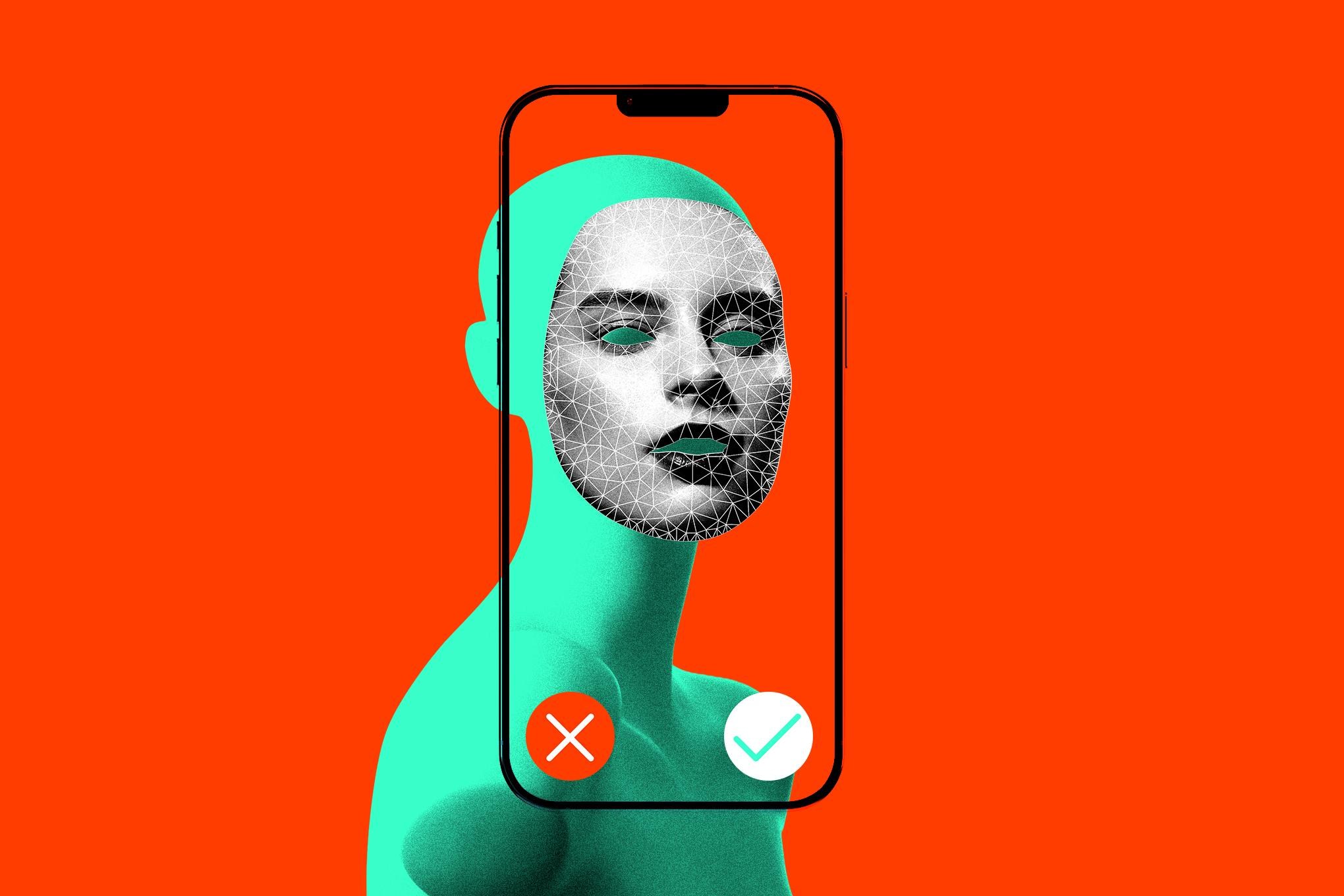
AITechThe sexy AI-powered dating app scams are hereThousands of people were catfished by scammers supercharged with AI.by Yael GrauerSep 16, 2026, 2:45 PM UTCShareGift Image: Cath Virginia / The Verge, Getty ImagesAITechThe sexy AI-powered dating app scams are hereThousands of people were catfished by scammers supercharged with AI.by Yael GrauerSep 16, 2026, 2:45 PM UTCShareGiftSecurity researcher Matthew “Zigula” Gore-Kormanik was analyzing a fraudulent dating app called Dora when he got a pop-up message saying he was receiving a call from Jennifer. According to her bio, she’s a 41-year-old Sagittarius with red hair, blue eyes, and piercings. She likes music, horror movies, nightlife, and sports.Gore-Kormanik answered the call, but didn’t see Jennifer in his video feed. He saw a tapestry that was moving, probably due to a fan, and heard weird distortion in the background.
After the call ended, “Jennifer” messaged him to say she’d had fun and “your voice is way better than expected.” His microphone hadn’t even been connected.Gore-Kormanik was poking around Dora, and other similar apps, because I’d shared with him a spreadsheet of potential dating scam apps. I was looking into this because on June 5th, Anthropic did something uncharacteristic: The normally tight-lipped company let its threat intelligence researcher Chris Cronbaugh give a talk at a public cybersecurity conference called Sleuthcon. The company had uncovered a fraudulent dating app network after noticing unusual activity on Claude: a prepaid account sending out over 100,000 API requests per day.The majority of chats did not involve a human agent at all.During the talk, called “Swipe Right, Pay Up: Industrial-Scale AI Catfishing,” Cronbaugh described a network of around 28 dating apps where the conversation was largely run by autonomous AI personas. The majority of chats, he said, did not involve a human agent at all.
Anthropic has since published its findings in the “scams and fraud” section of its “Detecting and countering misuse of AI: September 2026” report, but not until after we’d spent extensive time looking into the network and trying to corroborate the findings. I was intrigued by the fact that Anthropic was speaking about this publicly while many of the apps were still live on both major US app stores, and wondered why they hadn’t been taken down.Looking at the apps themselves, I noted that they were presented as helping people find people to talk to. They did not look like companion apps such as Replika where it’s clear the personas are actually AI. For example, Dora was described as “a dating app thoughtfully designed for wide range of ages people … a respectful easy-to-use space to meet people who share your values.” A different version said it was a “warm, simple dating app for adults seeking real connection.” Romi, the description stated, “helps you discover, connect, and chat with real people.” Doni’s tagline was “start real companionship”; the description said it “helps you connect with nearby singles.”Here’s how the scam works: Users, mostly men in their mid-to-late 30s, go on dating apps and match with what they believe to be real women.
Only one in four of them actually is, and that person is not a user looking for other dates but rather a paid gig worker.The gig workers were hired to pass liveness checks on video or to follow social media accounts. They didn’t even write their own comments. Instead, they responded to messages by selecting from three pregenerated replies. But they could prove they’re human, whereas the AI personas could only demur with a plausible explanation for why a video chat or call was not possible. “Backend components fabricated likes, visitors, and pre-recorded ‘video’ when no real person was available, and tracked which users had begun to suspect they were talking to a bot,” Anthropic’s report states.
Because of the smattering of interactions with real people, some users began to believe that the entirely AI-generated replies they were receiving on the app were also from real people.Multiple AI providers are involved. While Claude was misused to run the autonomous conversational personas, the report says that “a small non-Anthropic model generated the short reply suggestions the gig workers tapped, alongside face-attractiveness scoring and photo/voice moderation. An image-editing model generated avatar imagery.”There is an entire ecosystem of online scams, ranging from automated thirst trap replies to fake social media accounts or dating app profiles. In many cases, people spend months building trust before telling their victims that there’s an emergency and they need financial help.
Or they pretend to be investors, asking for money in an account they own that ends up being fake. But this is not your typical romance scam; there’s no money “borrowed” by fake romantic partners, nor is cryptocurrency involved.The apps are themselves the scam: They ask for coins for continued interactions, and the coins cost real money. Users buy them to continue talking primarily to machines, believing they’re talking to other humans. These gig workers keep the ruse going, while AI can keep conversations going 24/7 as the coins flow.The apps are themselves the scam.According to Anthropic’s report, the prompts the AI had been given kept the personas consistent, and the AI was operating as if the exchanges were “ordinary roleplay or companion deployment.” But the AI wasn’t told it was part of a scam because, the company wrote, “The monetization and deception were not visible from inside any exchange.”That said, the report said that “the model’s own reasoning surfaced the harm” in a small number of cases, including ones “where users disclosed serious illness or acute distress.” Even in those cases, “the output continued in persona.”We have additional detail because Gore-Kormanik found the internal protocol repository of the entire configuration, including files, code, and documentation of how the operation runs.
The manual, in Chinese, was shipped inside the dating app Doni, probably by accident.In the protocol repository, Gore-Kormanik found notes for monitoring gig workers to see whether their cameras were on and broadcasting, if they were reachable by message, and so forth. The app also takes screenshots and records calls, which are transcribed, with transcripts retrievable by staff. The proto repo described the stages of their processes as workers, including one where they rank their performances against one another, and how their pay can be based on calls and message engagements, or for getting Instagram followers. It even describes the process of pretending people called you in order to lure them into conversation.“I can attest to this because it happened to me firsthand,” Gore-Kormanik said.
He hit accept on a call he received through Doni, which quickly disconnected. The caller messaged him, asking why he had called her at 1 in the morning. The app plainly showed the call had come from her.“RANDOM VIDEO CALLS ARE ANNOYING. Having to purchase “gems” to chat w/a woman that might not even be real & just a chatbot is deceptive & downright scummy.”Watching the Sleuthcon talk remotely, I took a screenshot of one of Cronbaugh’s slides, which had logos for 10 companies.
Reverse image search helped me to identify many of the apps that ended up in Anthropic’s final report, including Dora, GraceChat, Jovia, Luma, and Romi. There were also other apps associated with the developers of those apps, such as Doni and Kira. (Anthropic listed some other apps in the report and said there were additional variants identified only by internal numeric. We looked into other apps that didn’t end up in Anthropic’s final report.)In early June, several of the fake dating apps were still live on the Google Play Store: Doni, Dora, Jovia, Nalo, and R









Leave a Reply