
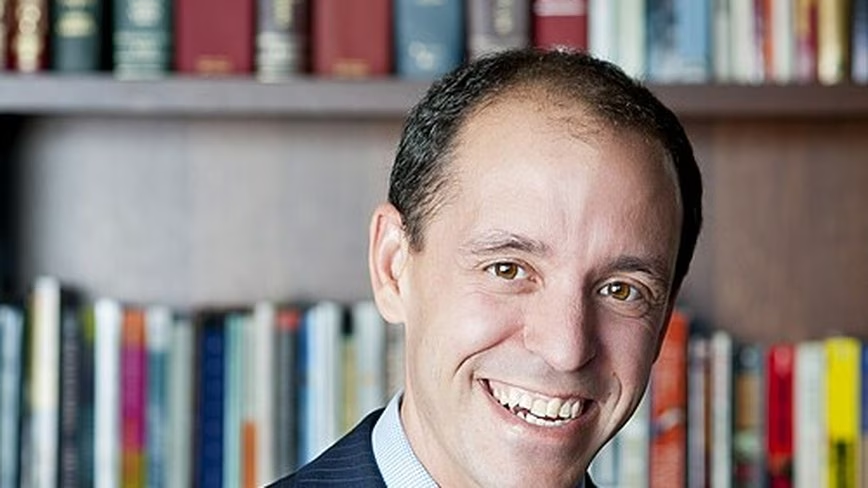
Chris Lehane, chief global affairs officer at OpenAI, photographed in 2012. Credit: Pupkin8r / CC BY-SA [version] via Wikimedia Commons OpenAI’s top political strategist Chris Lehane calls the industry’s turn to state-level AI lawmaking reverse federalism, while super PACs backed by OpenAI’s president and a16z spend heavily for a national framework that would override state rules. The company has separately asked California to toughen a state law it once fought and asked Congress for mandatory federal requirements. The one position that holds across every venue is that evaluation and reporting are acceptable and a gate on model release is not.
Washington spent the week arguing about whether the AI industry means it. President Trump called the case for slowing AI down a hoax, and Vice President JD Vance said frontier companies asking to be regulated felt like a Trojan horse. Ashley Gold argued in a Semafor column that this is the industry applying the lesson of the social media backlash: shaping regulation beats insisting you are harmless. Her piece contains the detail worth pulling out. The phrase OpenAI’s top political strategist Chris Lehane calls the state route reverse federalism, Gold reports.
Going to statehouses is easier than waiting for Congress, and the companies can live with a series of similar state rules. That is a reasonable description of how American policy gets made. It is also close to the opposite of what the industry and its allies have been funding for eighteen months. What the same side has been doing to state law Congress has rejected preemption of state AI rules twice.
The Senate stripped a moratorium from the budget bill by 99 votes to one. The executive branch kept going. An order signed last December set up a litigation task force to challenge state AI laws and directed Commerce to look at withholding broadband money from states with rules it considered onerous. States and Congress have both pushed back since. Preemption has also become tradeable currency, offered to Congress in exchange for passing a package of online safety bills.
And what the money wants The industry’s election spending is not ambiguous about the venue. Super PACs backed by Andreessen, Horowitz and OpenAI president Greg Brockman are putting hundreds of millions into the midterms, seeking a single national framework that overrides state-by-state regulation. So one part of the industry calls the state route reverse federalism while another part pays to close it. Both can be sincere, and they are not aimed at the same outcome. The state position is real, and recent This is not simply hypocrisy, which is what makes it interesting. OpenAI has asked California to strengthen the state AI law it previously fought.
The company has also gone the other way in Washington. It asked Congress for mandatory national AI safety requirements rather than voluntary ones. Read together, those are not a muddle. They are a company that will accept rules in any venue where it is in the room when the text is written. Where the line actually sits There is one consistent limit. Sam Altman has told Congress to fund AI testing but not to require approval before a model ships.
That is the distinction that survives every venue change. Evaluation, reporting, standards and embedded reviewers are all acceptable, and a gate on release is not. It is a coherent position and the industry has never really hidden it. It is just a different thing from being open to regulation, which is how the week has been described.
Two critiques, from opposite directions Vance’s Trojan horse remark is the incumbent-cost argument. Large firms can absorb compliance that smaller rivals cannot, so rules written with incumbents can entrench them. The same objection arrives from the left as regulatory capture, with critics arguing coordinated safety commitments would mainly serve the two companies proposing them. Vance and those critics agree on the mechanism and disagree about almost everything else.
Neither argument requires believing the safety concern is fake. It can be sincere and still produce a rule that suits the firms who drafted it. The case for taking it at face value The pressure this month did not come from nowhere. An Anthropic researcher resigned in public warning that the leading labs are gambling with people’s lives, and two disclosure failures at OpenAI preceded the calls for pacing.
Anthropic also committed to embedded external evaluators unilaterally rather than waiting for anyone to require it, and OpenAI said it would match that commitment. Doing a thing first is weak evidence of bad faith. The honest position is that motive is unknowable and structure is not. What can be checked is which proposals would bind a company that decided to stop cooperating.
Europe already answered the venue question The argument the US is having about federal against state rules is one the EU settled by legislating once, centrally, with obligations that attach to the model rather than to good intentions. That is not automatically the better outcome, and enforcement is where the European approach keeps struggling. It does remove the question of which venue a company would prefer to be regulated in. What to watch Watch the Senate bill that Majority Leader John Thune says is coming, shaped with Ted Cruz and Amy Klobuchar.
Cruz wrote the ten-year state moratorium the Senate killed almost unanimously last year. Watch whether any version reaches release decisions. A bill full of evaluation, reporting and standards, with nothing that can stop a launch, is the one the industry has been asking for all along.










Leave a Reply