
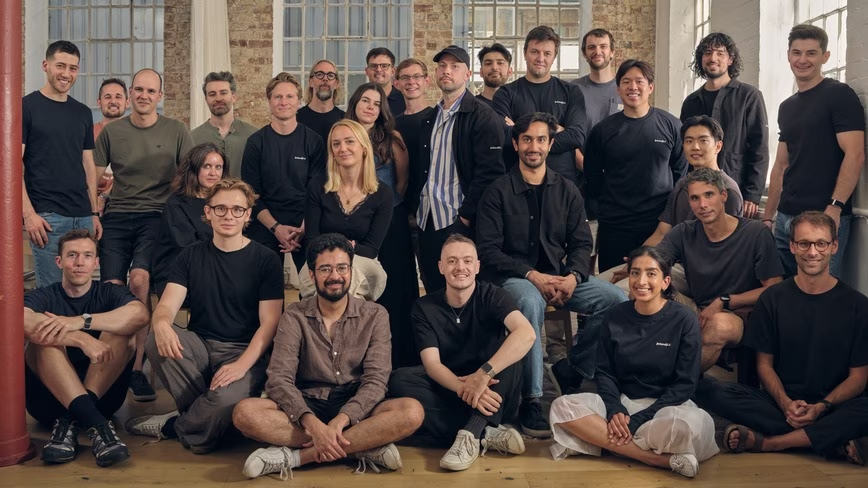
The Jack & Jill team Credit: Jack & Jill Jack & Jill has raised $40M in a Series A led by Air Street Capital, bringing total funding to $60M less than a year after a $20M seed round. Madrona and Antler are new investors, and Creandum, Ada Ventures, Entrepreneurs First, Expedite Capital, and Repeat.vc all returned. The product is two agents that negotiate with each other. Jack works for the candidate, learning what they want through voice calls, email, and WhatsApp.
Jill works for the employer, reading the job description and interrogating what success in the role actually looks like. When both conclude that the match is worth making, the candidate is introduced directly to the hiring manager and never fills out an application. Nathan Benaich, the Air Street general partner who led the round, describes the thesis as: “The next leap in hiring will not come from better searches over the same resumes or more automated outreach,” said Nathan Benaich, General Partner at Air Street Capital. “It will come from putting an agent on both sides of the table and making the introduction only when both sides would take the call.” Matt Wilson, the co-founder and chief executive, puts the candidate side more plainly: “Every company has someone paid to represent its interests in the job market. People have never had the same for their careers.” The traction figures are substantial.
Jack’s network has grown tenfold since the seed to 350,000 people. Jill has worked with 5,000 businesses, among them Ramp, Attio, Multiverse, Corgi, Tavus, Faculty and Fyxer. Between them, the agents have arranged 25,000 interviews and are now arranging 5,000 a month. One number is conspicuously absent.
Interviews arranged is an input, and for a company whose promise is that nobody applies for a job again, the figure that would settle the claim is how many of those 25,000 interviews produced a hire. That number is not given, nor is the base for the reported 40-fold revenue increase since the seed, which on a small enough starting point is compatible with almost any underlying business. What is genuinely novel is the depth of what people tell Jack. Users have spent 12,000 hours on calls with him in recent months.
One person has called 144 times and spent 44 hours in conversation, which the company offers as evidence of engagement, and this is also somebody who has spent more than a working week on the phone about their career. They tell him the manager they want to escape, the salary they are afraid to ask for, the problem they would take a pay cut to work on. Benaich’s argument is that no database holds that and nobody can scrape it. Regulation is the part the announcement does not address.
Recruitment and candidate evaluation are classified as high-risk under Annex III of the EU AI Act. The full obligations were deferred by the Digital Omnibus to 2 December 2027, but the Article 50 transparency duty was not deferred and has applied since 2 August 2026: anyone interacting with an AI system, automated phone systems explicitly included, must be told clearly at the first interaction. GDPR Article 22, covering automated decision-making, applies regardless. A voice agent that decides which candidates reach a hiring manager sits inside that perimeter.
The company is not alone in reading the market this way. Ethos raised $22.75m in May, led by a16z, for voice-agent interviewing that matches vetted experts to work, on the same diagnosis: candidate-side AI has made everyone look qualified while employer-side evaluation has not kept pace. Corporate job searches that once took four months now run twelve to eighteen, and employers are quietly rehiring people they cut for AI at lower wages. Saaras Mehan, the co-founder and chief technology officer, makes that displacement part of the pitch.
Wilson founded Omnipresent, the employer-of-record company Deel bought last year, and Mehan co-founded Kular and played chess for England. American interviews are running at nearly four times the London rate over the equivalent period after launch, which is a familiar shape for a British company and not a flattering one.











Leave a Reply