
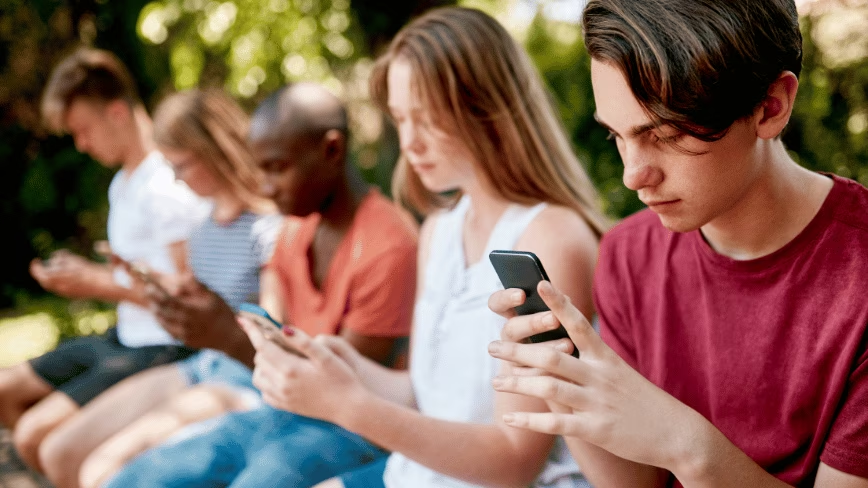
Credit: © Charday Penn / Getty Images via Canva.com The UK government will legislate to force Apple and Google to block nude images on children’s phones and tablets. The law would stop children taking, sharing or viewing them. Lisa Nandy, the culture secretary, told the House of Commons on 8 September that voluntary talks with the two companies had not gone far enough. In a statement to Parliament, Nandy committed the government to primary legislation.
It would require major tech platforms to build protections for children into their devices. She said it would come “as soon as we can”, but gave no date. Between them, Apple’s iOS and Google’s Android run most of the UK’s smartphones. Neither currently blocks the taking or sending of nude images across the whole device, Bloomberg’s Jacob Reid reported.
A deadline that ran out The move follows a three-month deadline the government set in June. At the time, it told Apple and Google to switch on built-in features or other technical fixes to detect and block nude images for children. Its June announcement warned that legislation would follow if they did not. That would include fines.
As a last resort, the government said it would explore criminal liability for tech bosses. Nandy told MPs the companies had made “significant commitments” since then. She pointed to changes at the operating system level and to Apple’s rollout of age checks earlier this year. “These proposals are a step in the right direction. However, the truth is, Madame Deputy Speaker, they do not meet the scale of this crisis,” she said.
The door is not fully closed. If the companies build and ship the protections while the government drafts the bill, Nandy said, it will reconsider whether a law is needed. What the law would do Prime Minister Andy Burnham said the protections would be “built into the device and switched on by default”, according to The Guardian. Adults who verify their age would be able to take, view and send nude images as before.
The government also wants apps that children use to stop them accessing or sharing nudity. Nandy said it would explore what further legislation that needs. The government has not yet settled which devices the rules would cover, Bloomberg reported. Nandy framed the scale of the problem in her statement.
Each year, she told MPs, around 9,000 child sexual abuse offences involve an online element. What Apple and Google say Both companies say they already offer some protections. An Apple spokesperson said the company added a feature in 2021 that stops children viewing or sharing photos and videos containing nudity. It now works with some third-party apps too.
The company said it had shared plans with UK officials to strengthen its Communication Safety feature further. A Google spokesperson said the company was “pleased to have made progress”. Google said it remained committed to working with lawmakers, developers and safety experts. It also stressed the need to protect privacy and access to information, The Guardian reported.
The companies have told ministers that the technology and privacy questions make this complicated, according to The Telegraph. One concern is ordinary images that users would not want blocked, such as holiday photos or a picture sent to a doctor. Support, and the privacy question Child safety groups backed the plan. “Children cannot face more delays, so Government must act swiftly,” Chris Sherwood, chief executive of the NSPCC, told Bloomberg. In the Commons, the Conservative shadow secretary of state, Rebecca Paul, called it “a huge practical step”.
She also said the details remained vague. Privacy experts are more cautious. Blocking images before they are sent implies scanning content on the device itself, known as client-side scanning. “Client-side scanning is the least evil approach,” Lukasz Olejnik, a visiting senior research fellow at King’s College London, told The Guardian. “That said, it does put in place an infrastructure to scan content of messages,” he added. Campaign group Big Brother Watch called child protection a noble goal.
It criticised what it described as digital ID checks and surveillance software, Bloomberg reported. Europe’s version of the same argument The debate has a long history across the Channel. In July, the European Parliament revived a child-abuse scanning bill that it had rejected in March. Brussels has also built its own age verification app for social media.
Age checks have proved hard in practice elsewhere. Testers found that Australia’s under-16 social media ban stumbled at the first age check. In France, a court struck down the country’s under-15 social media ban two weeks before it was due to start. The UK has its own under-16 social media ban on the way, which Nandy said is on track to take effect by spring 2027.
Ofcom has already opened a child safety investigation into TikTok under existing rules. The device law would go further, because current UK rules mostly apply to services rather than to the phones themselves. The next step is the bill. Until it is published, the key questions stay open: which devices it covers, how age is verified, and whether Apple and Google ship their own changes first.












Leave a Reply